evl-lib
6. Branches, loops and errors
Real flows branch, repeat and fail. EVL never guesses these from if, for or catch: a branch is only drawn when you say it matters. That keeps the map about business decisions, not every null check.
Decisions: ? segments
A path segment that ends in ? is a decision, drawn as a diamond. Its children are the arms, and each arm says when it runs with when:
@Flow("checkout")
public Receipt pay(Order order) {
    if (order.paidByCard()) {
        // @flow checkout>payment?>card: Charge the card [when card]
        cards.charge(order);
    } else if (order.paidByWallet()) {
        // @flow checkout>payment?>wallet: Debit the wallet [when wallet]
        wallets.debit(order);
    } else {
        // @flow checkout>payment?>cod: Cash on delivery [when else]
        orders.markCashOnDelivery(order);
    }
    ...
}
Drawn: checkout → ◇ payment? → three arms labelled card, wallet and else.
- You don’t tag the diamond itself;
checkout>payment?is created from its arms. To give it a question as its title, tag it once:// @flow checkout>payment?: How does the customer pay?. - A decision always shows its arms.
- The decision takes its place in the parent’s order where its first arm happens.
- Two different
ifs are two different decisions:payment?andstock?. They never merge by accident.
An arm with several steps
Go one level deeper:
// @flow checkout>payment?>card: Card [when card]
// @flow checkout>payment?>card>charge: Charge the card
// @flow checkout>payment?>card>receipt: Email the receipt
Nested decisions
A decision inside an arm is just another ? segment:
checkout>payment?>card>3ds?>challenge   [when 3-D Secure required]
checkout>payment?>card>3ds?>skip        [when else]
On annotations
When the arm is a method, use the attribute:
@Flow(value = "checkout>payment?>card", label = "Charge the card", when = "card")
public void charge(Order order) { ... }
In Kotlin when is a keyword, so write it with backticks: @Flow(value = "checkout>payment?>card", `when` = "card").
A single condition
If a step simply runs only sometimes, and there is no real “other arm”, skip the diamond and label the arrow:
// @flow image-upload>notify: Warn the user [when quota is almost used]
The arrow from the parent reads “if quota is almost used”.
Loops: each
// @flow image-upload>resize: Resize [each size in sizes]
for (Size size : sizes) resizer.resize(file, size);
or @Flow(value = "image-upload>resize", each = "size in sizes"). The box gets a “↻ each size in sizes” badge.
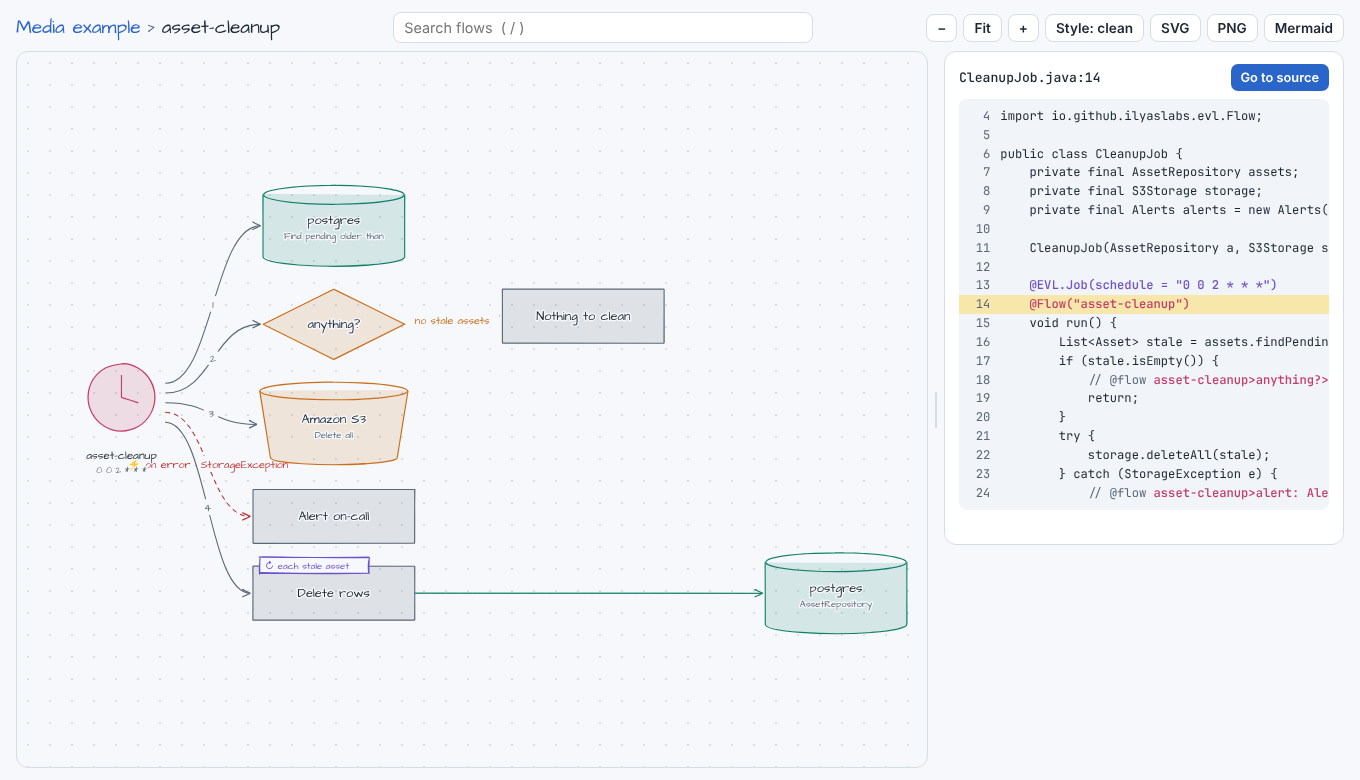
Error paths: onError
try {
    storage.deleteAll(stale);
} catch (StorageException e) {
    // @flow asset-cleanup>alert: Alert on-call [on error StorageException]
    alerts.page(e);
}
or @Flow(value = "asset-cleanup>alert", onError = "StorageException"). The step is drawn with a red dashed arrow labelled “⚡ on error · StorageException”, and it doesn’t take a step number, so it never looks like it always happens.
Refusals and guards
A guard that rejects a request (“only the uploader may complete”) is a meaningful branch. Write it as an error path or a decision arm, not a plain step, or readers will think it always runs:
// @flow media-upload>complete>check: Refuse, only the uploader may complete [when caller is not the uploader]
Bracket syntax summary
On inline markers, write any of these after the label, in any order:
| Bracket | Same as | Drawn as |
|---|---|---|
[when …] |
when = "…" |
arm label, or “if …” on the arrow |
[each …] |
each = "…" |
↻ loop badge |
[on error …] |
onError = "…" |
red dashed error arrow |